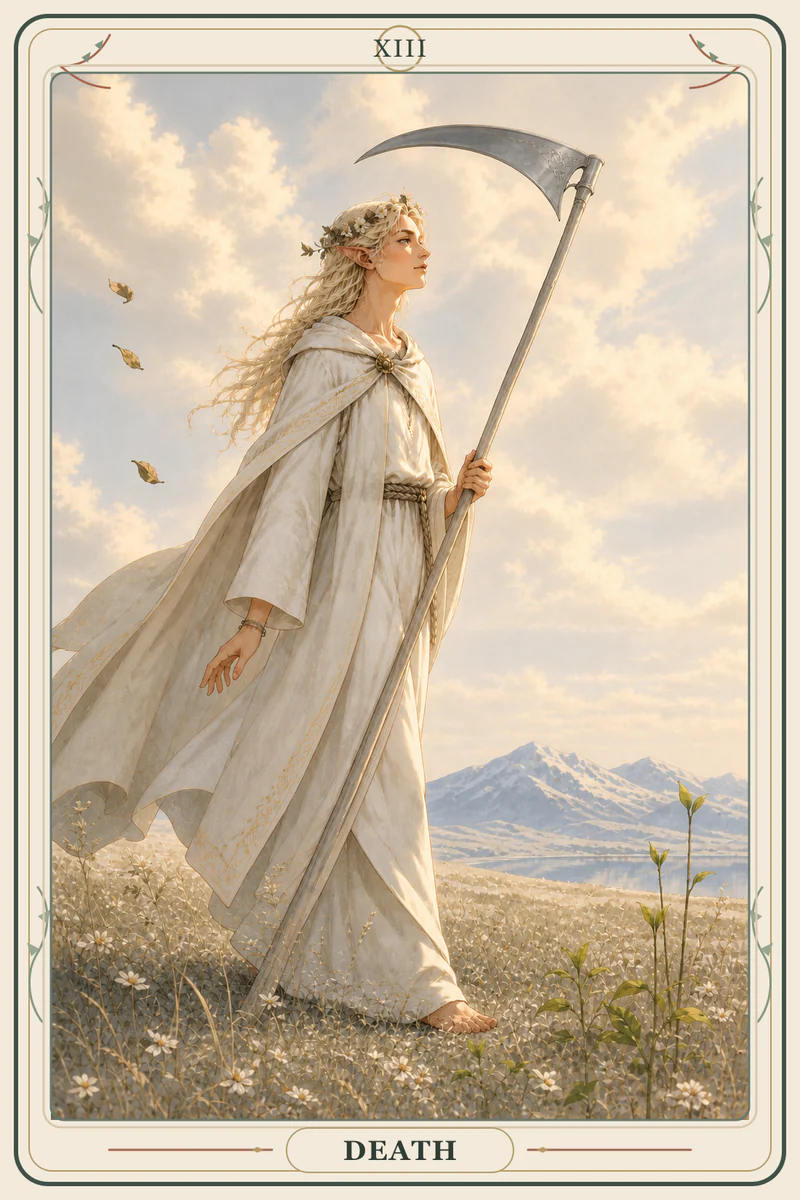
Major Arcana · 13
Death
The Death Tarot card means endings, transformation, and letting go. Upright, it asks what has run its course; reversed, it can point to resistance or a slower, inward change. It does not predict physical death.
Upright keywords
- endings
- transformation
- transition
- letting go
- renewal
Reversed keywords
- resistance
- stagnation
- unfinished ending
- fear of change
Overview
Death is numbered XIII (13) in the Major Arcana. Its central theme is a change that requires an ending: retiring an old habit, closing a chapter, or accepting that a familiar arrangement no longer fits. The name can feel alarming, but a Tarot draw is not evidence that someone will die.
Read Death in relation to your question and its position in the spread. As advice, it can invite you to stop maintaining an exhausted pattern. In a past position, it may describe a transition you have already experienced. Neither interpretation requires a dramatic event to happen next.
Symbols and imagery
- The scythe
- In Prefate's artwork, the raised scythe can be read as a harvest: recognizing what has reached its end and what is ready to be released.
- The standing figure
- The pale-robed woman gives this version of Death a quiet presence. Use her stillness as a prompt to acknowledge a transition without rushing to control it.
- Flowers and the distant landscape
- Flowers grow around the figure, with mountains beyond. This contrast offers an image of life continuing around an ending and a wider perspective beyond the immediate change.
Upright meaning
Death upright keywords are endings, transformation, transition, letting go, and renewal. Endings name what has completed its role. Transformation is the change in how you live after that ending. Transition is the uncertain stretch between the old arrangement and a new one. Letting go is your part in releasing the old form; renewal is the space that release can create.
For example, if you ask how to approach a stalled project, Death upright may invite you to retire a version that no longer serves its purpose. You could keep the useful research, close unfinished commitments, and decide what a smaller next version needs. It is a prompt to assess the project, not an instruction to abandon it without checking the facts.
An ending can bring grief and relief at the same time. You do not have to call a painful change a blessing or rush into a replacement. Acknowledge what mattered, complete what you reasonably can, and give yourself room to adjust.
Reversed meaning
Death reversed can describe resistance to change, stagnation, an unfinished ending, or fear of letting go. The difference from upright Death is often where the difficulty lies: upright brings the transition into focus; reversed asks what is making that transition hard to accept or carry through.
A quieter interpretation is that change is happening internally before it is visible to other people. You might have outgrown an old expectation but still be working out how to act on that insight. Slow progress is not automatically avoidance, and a reversed card is not automatically a bad sign.
Ask what is holding the situation in place. Is it attachment, an unresolved conversation, or a practical limit such as time or support? Choose one manageable step, such as setting a boundary or making a plan, instead of forcing a sudden break to satisfy the card.
Meaning in different contexts
Love and relationships
Upright, Death can suggest that an old relationship pattern needs to end. This might mean replacing an exhausting cycle of arguments with clearer boundaries, adjusting expectations after a life change, or acknowledging that a relationship has ended. The card alone does not tell you which situation is true.
Reversed, you might be revisiting an unresolved breakup or postponing a conversation about what has changed. If you are single, reflect on which expectations from a past relationship you want to carry forward. A reading cannot verify another person's feelings or intentions; use it to prepare an honest conversation.
Career and work
Upright, Death can frame the completion of a role, project, or professional identity. If that fits your situation, think about what needs a handover, what skills remain useful, and what you want a next role to offer. It does not predict dismissal or require you to quit.
Reversed, distinguish reluctance to change from a sensible need to prepare. Updating a portfolio, checking options, or arranging a conversation can make a transition more concrete without an impulsive decision.
Money and resources
A financial habit or arrangement may need restructuring. Make practical changes and seek qualified advice for high-stakes decisions rather than relying on a card reading.
Personal growth
Letting go can be an active practice. Recognize the identity, routine, or story that once protected you but now limits your development.
Practical guidance
Start with one sentence: ‘The pattern I am ready to change is…’ Name something specific enough to act on, such as agreeing to commitments you cannot sustain. Then separate what you want to keep from what you want to stop repeating.
Choose one small act of closure: finish a handover, clarify an expectation, or put a completed project aside. Write down what you chose and return to it after you have tried the action, rather than drawing repeatedly for a more reassuring answer.
In a three-card past, present, and future reading, Death in the present could frame a transition between an established habit and a possible next direction. Read the other two cards as context, then ask what you can change now. The future position offers a direction to reflect on, not a fixed deadline or guaranteed outcome.
Questions for reflection
- What has already ended even if I have not admitted it?
- What meaning can I keep without keeping the old form?
- What space would open if I released this?
Related guides
Related cards
Frequently asked questions
Does the Death card predict physical death?
No. In ordinary Tarot practice it is read as an ending, transition, or transformation, not a literal diagnosis or prediction of death.
Is Death always a negative Tarot card?
No. Endings can be painful, welcome, or both. The card focuses on necessary change and what becomes possible after release.
What are the Death Tarot card's upright keywords?
Endings, transformation, transition, letting go, and renewal. Together, they describe completing an old phase and making room for a different way forward. Apply the keywords to your question rather than assuming every part of your life must change.
Does the Death card mean a breakup?
Not necessarily. It can describe the end of a relationship pattern, an expectation, or a relationship itself. Look at what is actually happening and talk with your partner; the card is not proof that separation is inevitable.
Is the Death card a yes or no?
There is no universal yes-or-no answer. If you ask whether everything will stay the same, Death's theme challenges that expectation. If you ask whether to make a change, use it to examine what needs to end and what practical support you need, rather than treating it as permission or a guarantee.
What does Death mean in a future or outcome position?
It can suggest a direction involving closure or a change in the current pattern. It does not specify a date, predict physical death, or make an ending unavoidable. Ask what choices are available now and how the other cards add context.